Reconsidering Gardens after a fire experience

Cathy Olive will be presenting at this event which will be held at the Creightons Creek Hall on Sunday 24 May between 10am-12pm – see the attached flyer.

This forum is an opportunity to learn more about how you can plan a more fire-smart garden that has risk reduction at its heart.

The keynote speaker is John Rayner (Burnley Horticulture). We’ll also explore some case studies from local garden designers Miranda Yorston and myself (Neil May) as well as local gardener Annette Radford. We’ll also hear from Euroa Arboretum’s Cathy Olive followed by a panel style Q&A.

Whether your garden was impacted by the recent fires or you’re simply re-assessing the risk of your garden, this session will cover a broad range of topics including design principles to reduce fire risk, the importance a garden plays in our health and wellbeing as well as practical advice on what to do next.

There’ll be a coffee van onsite and a BBQ lunch will be served after the session.

Please RSVP via the QR code on the attached flyer or email this address.…

Communications Coordinator role advertised

We are looking for a Communication Coordinator. Casual, approximately 4 hours per week (8 hours per fortnight)

The Communication Coordinator is responsible for developing and maintaining digital platforms to ensure efficient and fit for purpose communications both internally and externally. This will include the development and presentation of visual aids, advertising, newletters, storylines, and pictorial libraries to promote the Arboretum and its partners.

Download the postition description

About the Role

The Communications Coordinator is responsible for developing and maintaining digital platforms to ensure efficient and fit for purpose communications both internally and externally. This will include the development and presentation of visual aids, advertising, newletters, storylines, and pictorial libraries to promote the Arboretum and its partners. An extension of the role includes the development and maintenance of IT systems within the Arboretum and Goulburn-Broken Indigenous Seedbank.

Key Selection Criteria

The KSC can be viewed in the position description.

Why work with us?

  • Meaningful work to support real on-ground biodiversity & landscape restoration outcomes
  • Flexible, family-friendly and collaborative working environment
  • Innovative & ethical leader in the restoration space

How to apply

Apply by 15 May 2026 via info@euroaarboretum.com.au and submit your resume along with a cover letter which includes brief/short responses to the key selection criteria.

Enquiries to Rose Young, Commercial Manager via the email provided or 0429 127 399…

Nature is resilient – right? Australia is adapted to fire – yes?  

Australia is adapted to fire – yes?  These statements are true – to some extent.  On a recent walk in the burnt country near Ruffy, I was encouraged to see 5 plants of Woolly Wattle with little seedlings under their branches.  Woolly Wattle, Acacia lanigera var lanigera is listed as Vulnerable, and these 5 plants are all that exist across the Tablelands.  They have been munched by deer for years and have not produced any new seedlings for at least a decade that have been noted.  Those few little germinants were cause for celebration.  Kangaroo grasslands, well adapted to fire, were thriving and orchids were abundant.  Signs of life were everywhere if you looked hard enough, despite the loss of some truly magnificent, rare old trees.  It appears nature is rebounding and the green brings a sense of hope and reassurance.

However, this is only part of the story.  Our farming landscape has fragmented biodiversity, and being fragmented, it becomes so much more vulnerable to disturbance.  If we liken nature to a knitted jumper, the pattern and function of the jumper works as a whole. Drop a stitch, and a little hole soon develops.  If the moths get into your cupboard and eat multiple holes, each stitch starts to unravel and the jumper begins to look pretty ragged and be less functional at keeping you warm.  If we cut the jumper into 40 identical pieces, is it still a jumper?  Does each little piece display the pattern or function of a jumper?  Is it prone to fraying, or loss as it is moved around?  Is it vulnerable to mould, decay and fire as 40 separate pieces?

Our farming landscape is a little like our jumper.  It is the complexity of nature that supports maximum diversity.  Our agricultural landscape, even with sustainable agriculture, will never be as diverse as a native landscape.  It is the structure with trees, shrubs, grasses and woody debris that functions as a whole to support a myriad of insects, that then support birds, reptiles and mammals. So what has this to do with recovery from fire?

Our landscape at the moment is terribly vulnerable.  It is just beginning to regenerate.  However, many of the connections across our land have been burnt, making it impossible for birds, insects and mammals to move across open country and re-populate safely.  Many of our insect eating birds, like Yellow Robins or Song Thrush won’t move across much more than a 40m opening in a paddock.  We still have introduced predators like cats and foxes, and herbivores like deer and goats, preying on vulnerable plants and animals.  We need to act now to protect plants and animals and give them the best chance of regenerating.

G2G, BRA have been building a series of monitoring and action projects to involve community through citizen science and hands on help, to ensure we give our landscape the best shot of recovery.

Thanks to generous help from Rushworth Field and Game and many other groups, we have 150 nest boxes ready to install.  Thanks to prompt donations, we have purchased enough marine ply to build another 350 nest boxes and will be distributing the ply to various mens and womens sheds to ‘flat pack’ our boxes so community groups can help with assembly.  The Arb bush crew head off for working at heights training tomorrow – the generous donation from Naked Wines will be used to ensure we cover OH and S training and get those nest boxes installed in key locations.

Jemma Norman, with Victorian Game Harvesters and some trusted local shooters has been building a deer control program.  There are game cameras installed around Ruffy locations, and early signs are indicating we still have large numbers of deer in the burnt landscape.  Its imperative we work cooperatively across the landscape and across public and private land tenure to reduce deer numbers while our bushland and farmland is regenerating.  If you are interested in deer control on your property, please get in contact with Jemma and complete a landholder permission form for access purposes.  From there, our shooters will coordinate their movements and get in touch with landholders to conduct initial property walks.

To register your interest in having a shooter assist you, please contact Jemma Norman at facilitator.lpcmn@gmail.com

Our first community bird survey begins in Longwood East this Sunday.  Participants will be paired with experienced birders and learn how to record their sightings.  Building the picture of how our birds are recovering, and who is missing from the picture, helps us understand what else is missing in terms of habitat.  Expert Chris Tzaros will be independently completing bird surveys across 40 sites and comparing them with pre-burn information. 

In the background, Bert Lobert has been designing a monitoring program for Greater Gliders around Caveat and Dropmore.  While Greater Gliders will be our ‘premier’ species to watch for, observation techniques will also provide evidence of other arboreal mammals and deer in the landscape.  Janet Hagen is working with Zara Marais to design a spring soak monitoring plan, and will be comparing results with previous surveys conducted some years ago, and Helen McKernan is co-designing a study on the effects of fungi and the significance of beneficial fungi to assist with regeneration after fire.  Bronte Haines has outlined a project to watch for grassland recovery with Jessie Sinclair from Zoos Victoria, and I’m developing a plan to keep an eye on our threatened plant species.  Allison Trethowan is working on how we can connect you, our community, to each of these activities and creating opportunities to get involved.  

We hope that each of these activities will create a template for how we assess and respond to our landscape as it recovers from fire.  We hope that it will build a story, and that many of you will choose to be part of the story, in whatever capacity you have to be involved.  

So where does our knitted jumper fit in with this story??  Well, our landscape is not a jumper anymore.  But if we follow this analogy, it could be a scarf!  Or a beanie, or even a vest.  Peter Richardson, our final member of the G2G team, has skills in sustainable agriculture.  In the words of Janet Hagen, our landscape is a ‘blank canvas’ currently, stripped of fencing and artificial division.  Peter will be working with the team on how we identify corridors and links across our landscape, to improve the outcomes and profitability for farming, but also our plants, animals, water quality and soils as they recover from the fire.  

Cathy Olive
Development Manager
Euroa Arboretum…

An Update on Granite to Goulburn; Biodiversity Recovery Alliance Activities:

Since January 2026, we’ve been working tirelessly.  The following projects give a little insight into what we have been doing to support environmental recovery.

Our ancient trees and their habitat:

Estimates indicate about 90% of our hollow bearing trees have burnt and either fallen or been cut down since the fires.  Many birds and mammals depend on hollows for habitat, either for protection or during their breeding season.  The loss of these trees is immense and it will be decades before new hollows form in many of the current trees.  However, we can help.

G2G BRA have been working alongside Murrindindi, Strathbogie, Mitchell and Mansfield Shires as they work on opening our roadsides for safe travel and reducing roadside fire debris.  Hollow logs and branches have been salvaged and where possible, ideally left as roadside habitat.  Its imperfect, with so many contractors to supervise and manage and with few staff to do so, but all the shires are now working together to support each other and improve the habitat outcomes on our roadsides while reducing future fire risk. 

Rushworth Field and Game group wasted no time on building nest boxes with Rushworth Secondary College for the fire recovery efforts to create artificial habitat.  Along with other groups supplying nest boxes, we now have at least 200 boxes ready for installation in the coming weeks.  Just in time for cold weather.

Landcare networks Up2Us, Upper Goulburn and the Arb have applied for funds for materials for nest boxes to begin mass production and installation.  Thanks to timely support from donations, we will be able to immediately begin purchasing material and work alongside of men’s sheds and community groups to make nest boxes.  Our goal is to install 1000 boxes in 2026.  

Assessing the damage, designing monitoring and citizen science programs.

Early on ground and mapping assessments indicate most areas of the tablelands were burnt to varying degrees of severity.  The only areas to escape the radiant heat were some spring soaks and parts of main creek systems – the Hughes and Boggy Creek and Crystal Brook.  

After the breadth of damage from fire, it’s important to understand the recovery of plants, fungi and animals and make timely interventions as needed.  We are grateful for the support and knowledge sharing of a wide range of scientists at a recent scientific roundtable to begin building monitoring for habitat recovery.

Key ideas were keeping it simple, repeat monitoring when there is already baseline data present, monitoring a focal species to ensure a cohort of animals and plants are recovering, and repeat monitoring over a number of years.  We are busy building citizen science projects for our keen volunteers, and look forward to working alongside dedicated science teams as we watch country recover.

Blake from Victorian Game Harvesting has swung into action with his team to begin monitoring for deer activity.  If your property is on Hughes or Boggy Creek, or Crystal Brook, we are keen to hear from you if you are interested in reducing the pressure of deer on regeneration of native plants and your farm.  As these river corridors have been less intensely burnt, we estimate that these will still be strongholds for deer activity – a major concern for fragile country as it regenerates.  

Creating a ‘hub’, developing activities to support mental health and ecogrief.

With so many people of the tablelands without homes, Janet Hagen was keen to create a meeting point for displaced, local community.  Shirley Saywell to the rescue!  Shirl has provided Klofty’s mechanics garage as a location for G2G, BRA to call home in Euroa, conduct workshops and meet for a cuppa.  Klofty’s is open most Thursdays and Fridays.

Allison Trethowan, our G2G BRA facilitator, with some recent funding support, is developing a calendar of walks, art activities and citizen science to support our community.  Watch this space and join an activity soon.

Garden design courses in Strathbogie and Mitchell Shires

The fabulous Lou Costa has completed another popular garden design course, and Mitchell Shire are soon to host a garden day at Granite Hills Nursery.  Bringing joy, colour and new growth to your garden is high on our priority list at the Arb and with other garden growing initiatives.  Planting season is almost upon us – we look forward to hosting and supporting local initiatives as you rebuild your gardens.  

However, we ask that you hold off major plans to replant remnant vegetation or revegetation in 2026.  Watch how your patch recovers and you may well be surprised.  If of course it doesn’t regenerate, we will help you replant in 2027. 

The Arb

From the Arb team, we hope you have finally slowed pace to a trot and are taking a breath.  We will continue to provide articles, podcasts and information about how country is recovering and we will continue to advocate for country and our community.  

All of the seed collected in previous years from the fire affected country is on hold in the seedbank – quarantined to be grown into seedlings and planted back on country in the next few years.  Wildflowers are germinating in the nursery, ready for your gardens this spring.  Nest boxes will start to be installed in the next few weeks in readiness for the winter ahead for animals dependent on their shelter, and we are working madly to establish predator and weed control programs.

We look forward to seeing you soon.

Cathy Olive
Euroa Arboretum Development Manager

Special thanks for your help to:

  • Rushworth Field and Game
  • Rushworth Secondary College
  • Up2Us Landcare Network
  • Upper Goulburn Landcare Network
  • Goulburn Broken Catchment Management Authority
  • CFA biodiversity team
  • Trust for Nature
  • Zoos Victoria
  • Central Victorian Biolinks
  • Deakin University
  • Abzeco
  • Doug Frood
  • Murrindindi, Strathbogie, Mitchell and Mansfield Shire environment teams
  • Agriculture Victoria

For philanthropic support and donations we are deeply grateful to:

  • William Buckland Foundation
  • The Collie Foundation
  • Naked Wines
  • Goulburn Murray Landcare Network
  • Goulburn Valley Environment Group
  • And so many individuals – your donations mean the world to us and go a long way.

Two bush crew members knocking in stakes for guarded plants

What is a Seed Orchard?

Seed Production Areas (SPAs) are dedicated plantings of native trees or shrubs of known seed origin that are managed specifically to produce a reliable supply of high-quality and genetically diverse local seed. At the Euroa Arboretum, these plantings support large-scale ecological restoration projects across the Goulburn Broken region.

Plants in the SPA begin as seed, collected from healthy remnant populations across the region. Seed is sourced from multiple sites to capture local genetic diversity, and usually includes a proportion of seed from warmer and drier regions which builds resilience to future climate conditions. Often, seed from historical SPAs is reintroduced, adding valuable diversity, and further strengthening the genetic base of the planting.

Plants raised for our seed production areas are carefully grown in the Euroa Arboretum nursery before being planted together in rows, allowing for cross pollination, and allowing easy access for watering, maintenance, and future collection. 

Avenel SPA

In 2024, staged works began on a new 14-hectare Seed Production Area (SPA) in Avenel, with support from by Goulburn Valley Water, the Natural Resources Conservation Trust, and the Goulburn Broken Catchment Management Authority.Between 2024 and 2025 we planted:

  • 1000 Acacia montana (Mallee Wattle), 
  • 600 Acacia flexifolia (Bent-leaf Wattle),
  • 1200 Acacia acinacea (Gold-dust Wattle), and 
  • 1400 Acacia pycnantha (Golden Wattle). 

The Bush Crew prepared the site with slashing and spot-spraying followed by many weeks of planting. In addition, up to 1 hectare was hand-sown with native groundcovers including common everlasting, sticky everlasting, clustered everlasting, and hoary sunray. These plantings represent genetic material from 45 wild populations and 24 existing SPA populations.

Looking forward

Expansion at the Avenel seed orchard will continue this year, with a further 9 hectares to be established through BushBank funding from DEECA. Three additional species—Acacia genistifolia (Spreading Wattle), Acacia verniciflua(Varnish Wattle), and Acacia paradoxa (Hedge Wattle)—will be established, totaling 4,400 plants. Together, these represent seed collected from 42 wild populations and two existing SPA populations. Preparations are already underway, with plants being grown at the Euroa Arboretum Nursery and site works scheduled for autumn. 

Early signs of growth from previous plantings are encouraging. Acacia flexifolia and Acacia montana are already showing bud development, suggesting that a small initial seed harvest may be possible by the end of the year. Meanwhile, Golden Wattle planted last year has recovered strongly from earlier kangaroo browsing, with new growth now pushing well above the tree guards.

Once completed, the Avenel Seed Orchard will cover close to 25 hectares, and include approximately 8,500 plants across 11 species. It will represent more than 85 wild populations and around 25 historical SPA seed lots. 

By concentrating diverse local genetics into one managed planting, SPAs ensure a long-term supply of high-quality bulk seed that can be harvested efficiently, while reducing reliance on limited and vulnerable wild populations. 

Why Seed Production Areas Matter Reliable seed supply: consistent local native seed for large-scale restoration.
Protect wild plants: reduce pressure on small or fragmented populations.
Boost genetic diversity: mix seed from multiple sources for resilience.
Climate-ready plants: include genetics suited to hotter, drier conditions.
Efficient harvest: collect large volumes from a single site.
Overcome wild limitations: wild seed can be scarce, seasonal, or patchy—SPAs provide a dependable source.

by Mim Zimmerman

Bush Crew & Seed Production Area Coordinator

Birdsong and Growth: A Walk Through Recovering Landscapes

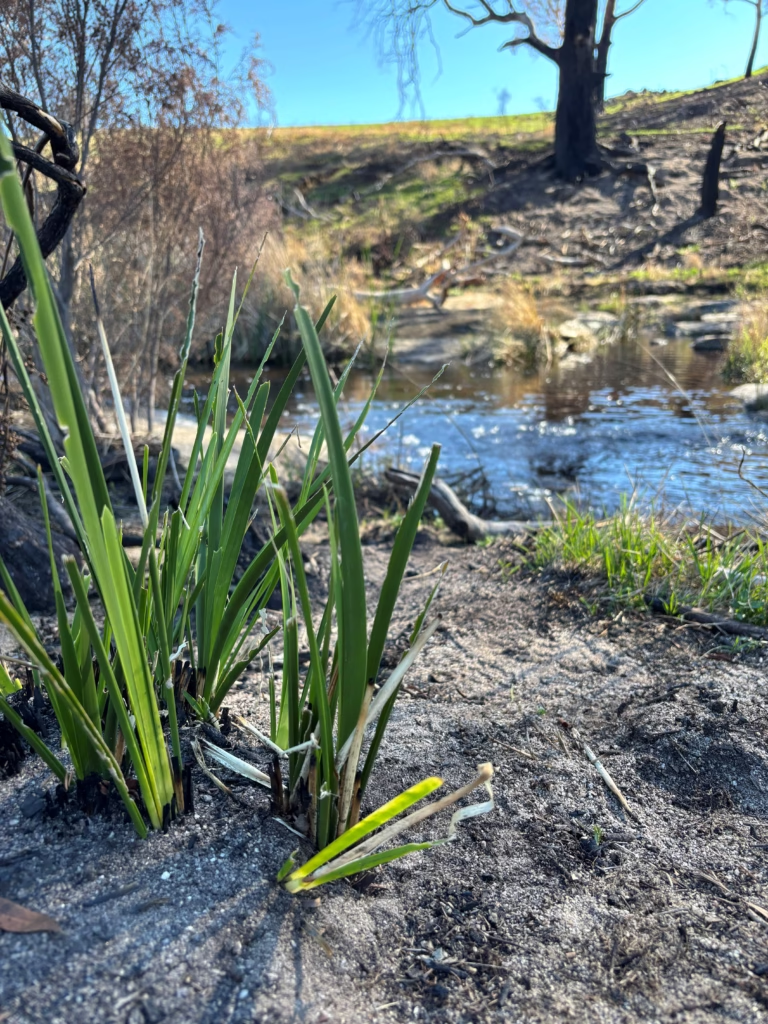
A recent walk downstream from Boathole, Ruffy, showed welcome signs of recovery. While it’s hard to watch our precious places that we love after fire, being present, with a group of like-minded souls, allowed us the opportunity to observe, marvel and celebrate incremental change. Epicormic growth on trees, native grasses and sedges sprouting, pockets within the spring soaks that retain thickets of vegetation – burnt at the edges but not in their damp centre.  A few dense shrubs remained unburnt in the creek bed, a haven for small birds to flit from and around.  Sorrel, a fast responder, opportunistically making the most of bare soil in the paddock and bolting fast.  Meek, unremarkable mosses on granite boulders, soaked overland water like a sponge, and with the sedges and Common Reed, sediment was trapped.  Little erosion was evident from recent rains, despite the downpour and exposed soils.  Wattles and peas weren’t observed in abundance, but I’m sure they are poised and not far away from germinating. Our creeks, rivers and spring soaks are the lifeblood of Country.  Local creeks like Hughes Creek and Crystal Brook show signs of burning less intensely in parts, and plants are responding rapidly to recent rain and increased water flow.

What of the wildlife?  Who is out and about?  Our first encounter in the paddock was an echidna, snuffling for ants.  Birds of prey, while not observed, have been noticed by many to be busy since the fires.  When conducting cool burns there is always a Wedge Tailed Eagle on patrol.  The bird telegraph is quick to respond and eagles, kites and falcons zoom to the fire ground.  Its easy picking through the dead, but there is also little cover to hide after a fire.  Lizards, snakes, mice and small birds are all vulnerable with little habitat available on the ground or in the shrubs.

Larger birds, like magpies, kookaburras and choughs return quickly.  They are robust and their sharp beaks mean they are hard to argue with.  They are also meat and carrion eaters and are happy enough in open farmland.

Parrots will move around the landscape following food.  They are seed eaters – larger parrots tackling She Oak and Eucalypt fruits with tough beaks designed for cracking.  Smaller grass parrots will be waiting for spring and grass seed flowering again.  Its unlikely we will see them for a while.

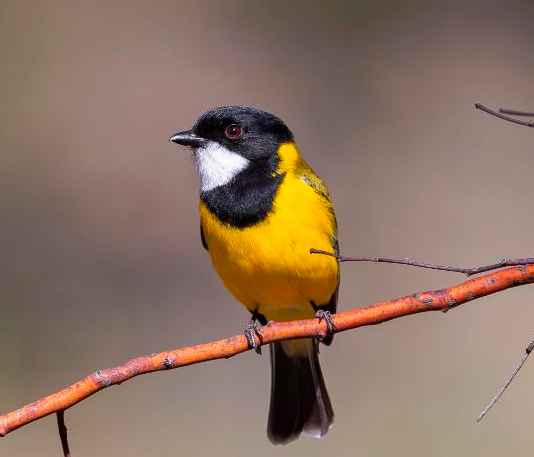
Following the Hughes Creek downstream, we were thrilled to hear bird song.  Lots of busy action across the water, just enough trees and shrubs to zip into and hide should a predatory bird be about, and tricky to access for a fox.  Janet’s eagle eyes and sharp ears detected Rufous Whistlers and Grey Fantails.  Invertebrates hatching from the water or insects coming to lay eggs were being rapidly snatched from the air.  These little birds, zippy and nimble, had found a ready food source.  Given enough shrub cover and a return of insects, these little insectivorous birds will spread beyond their creek environment.  They are wary moving across open country, much beyond 20 – 40 metres is their limit.  Creating wide corridors or ‘nodes’ of vegetation with deep protective plant cover and prickly dense shrubs provides perfect habitat.  Keep watch for these birds, finches and wrens – they will let you know when their habitat is just right.

Absent at this stage were the little honeyeaters, finches and wrens.  These little fellas are the most vulnerable and not much of their food resources remain in burnt country at the moment.  A handful of grevilleas or shrubs in a garden aren’t enough for them to thrive.  Watch for the Blue Wrens, they are quick to move in when the shrubs begin to grow.  Planting prickly, dense shrubs offer good cover and room to hide if you are a little bird.  Be mindful of too many nectar producing shrubs.  Often this attracts the bullying Wattle Birds or Noisy Miners.  They can dominate and drive out smaller birds.

Find a friend, take a walk, be curious and prepare to be amazed at nature’s resilience.

Cathy Olive
Development Manager

wildflower mondays

Hands-On Biodiversity Management in Grassy Woodlands

Wildflower Mondays returns after our summer hiatus. Join Bronte for some hands-on-dirt experience managing Grassy Woodlands for biodiversity! From April to November we gather in the grounds on the first Monday of the month to care for the precious groundstory layer. Learn about our indigenous groundcover species, including lilies, forbs and grasses, while assisting the Arboretum to restore and care for the biodiversity of our shared patch. Learn the skills required to establish and maintain a grassy meadow garden, or native grassland on your property, while helping tend the beautiful grounds of the Arboretum.

2026 plant orders open

Order your 2026 plants now

Our current plant order form reflects what’s available now and is kept up-to-date.

Orders will be fulfilled as best as possible, but supply for bushfire recovery may be prioritised or reserved for where and when needed.

We will be in contact if that’s the case. In the meantime, download our order form and submit now. We grow to order and you choose the month when plants are collected.

Our retail nursery opens again in March, date TBC.

Thanks from the Arb Nursery Team

Let Nature Recover, but Help Where We Can

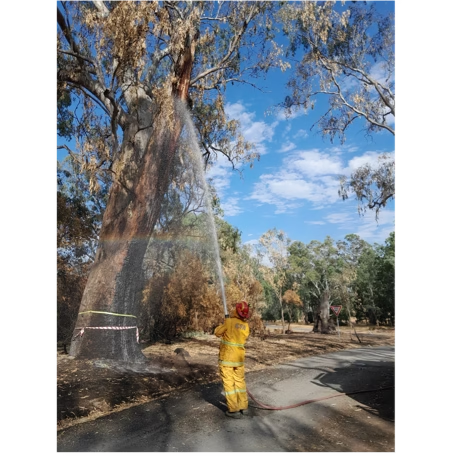
Thanks for helping save one old tree!  Great to see DEECA and CFA crews working hard to save this old tree.  She lost her 4 – 600 year old neighbour last week in the fires, and we hope she is finally extinguished in her hollow core.

There is no escaping the impact of the Longwood fire – either in the tired faces of friends and family, burnt hills and fences, ancient trees collapsed on roadsides or in paddocks.  The ancient trees have taken an unfair battering in these fires, where many hollow bearing trees have succumbed either to the flames, or to the chainsaws where trees have been deemed dangerous.  While we focus initially on ensuring our community and our animals are safe, we grieve our landscape too – how can we best support nature at this critical stage. 

First and foremost a reassurance – nature is resilient.  She is adept at recovery from fire, but we can help We have worked in environmental restoration for decades, and many of us have experienced times like these in the past. Here is what we have found has helped:

  1.  Take a moment and a breather. Take some photos of your burnt country.  It’s important to look back in a month or two and remember how much has changed.  Already the grass re-shoots.
  2. Many of the younger trees, while burnt, won’t be dead.  Give them time.  However, our old ancient trees, hollow throughout, have been decimated.  Ideally, if it is safe to do so, leave them in place or retain them as habitat on the ground.  Other alternatives could be to place logs in creek corridors as habitat, or around existing paddock trees, away from the trunk. Stock can still access shade from paddock trees, but this timber will provide a place to scratch and also prevent compacting the roots of the old tree. 
  3. Protect your creeks, dams and springs. Without groundcover, they are vulnerable to silting up during the next rain. In creeks, silt reduces habitat diversity and extra nutrients can lead to low water oxygen. Silt traps, which can be as simple as logs placed across the contour or over a gully, can help slow the flow and deposit of sediment and loose soil.  Keep an eye out for silt trap workshops coming soon.
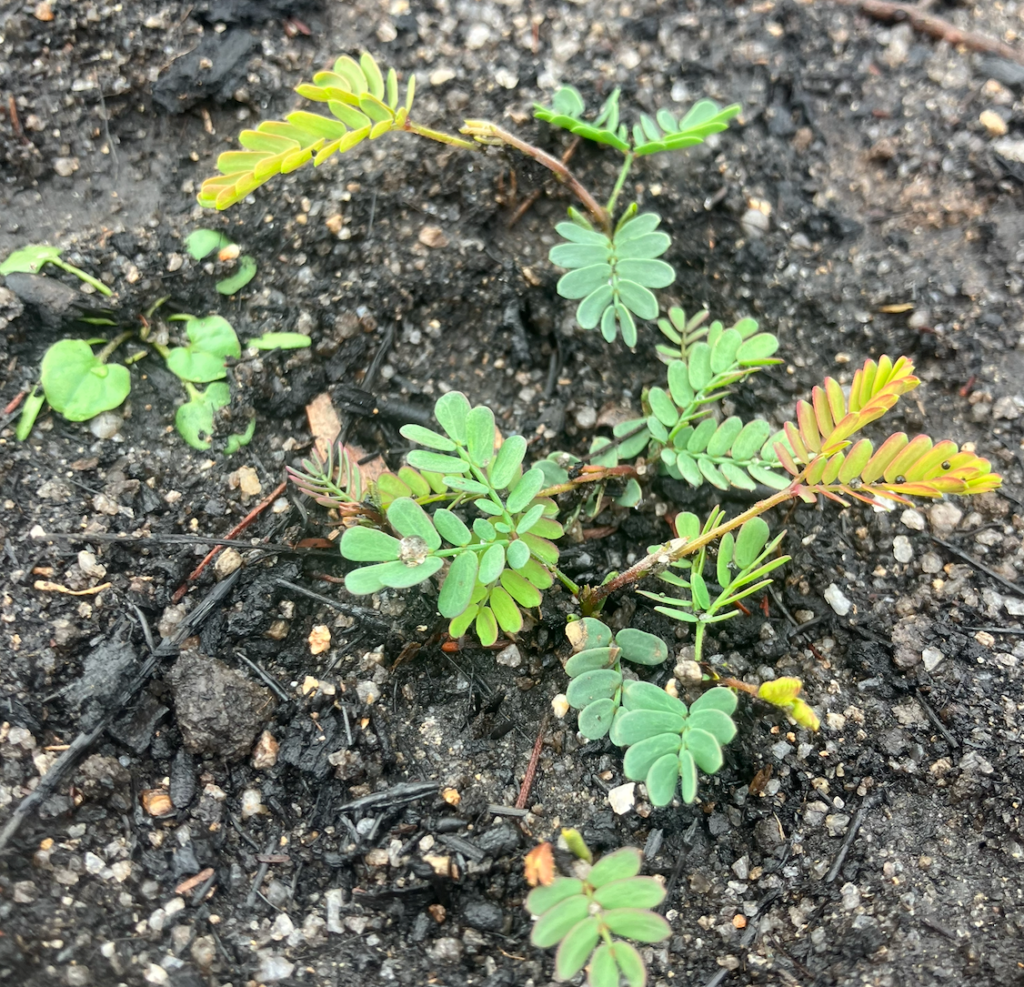
  4. While it looks denuded, watch your bushland patches for germination.  Seed often needs heat to crack the seed coat. Wattles and peas are likely to pop up, potentially species you have never seen before!  This can also be a good opportunity to target weeds while they are small, giving our natives the best chance at healthy re-establishment. 

Environmental groups in the burnt country have formed an alliance – Granite to Goulburn, Bushfire Recovery Alliance.  Bushfirerecoveryalliance.com.  We will be working with you, our community, in the years to come.  You are not on your own.